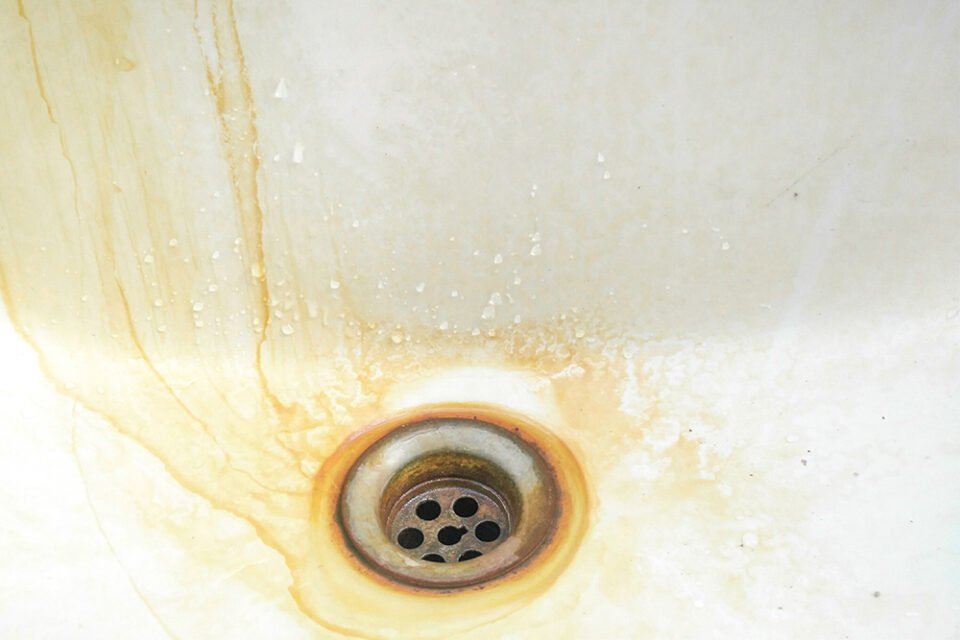
A little orange stain around the bathroom faucet doesn’t seem like a major household problem. Neither does a crusty ring around the showerhead or a cloudy film left behind on freshly washed dishes.
But when these things keep coming back, they’re worth paying attention to.
Water leaves clues. Sometimes those clues are simply signs of mineral-rich water. Other times, they can point toward iron, manganese, plumbing corrosion, or another characteristic of the water supply. The frustrating part is that several different issues can produce similar-looking symptoms.
That’s why scrubbing harder isn’t always the answer. You can clean the same stain every weekend and still be treating the symptom instead of the cause.
Understanding what is actually happening in the water is a much better place to start.
Orange Stains Often Have a Story Behind Them
Few household stains are as recognizable as the rusty orange or reddish marks that appear around sinks, toilets, tubs, and laundry fixtures.
One common cause is dissolved iron in the water. When iron comes into contact with oxygen, it can oxidize and form particles that settle on surfaces.
Over time, iron causing rust stains and build-up can become a persistent nuisance. The stains may appear around faucets, inside toilet bowls, or wherever water regularly sits and evaporates.
This doesn’t necessarily mean the plumbing is literally rusting. The iron can be coming from the water itself, particularly in some private well supplies.
A water test can help determine whether iron is present and, importantly, how much.
Hard Water Leaves a Different Kind of Mess
If the stains in your home are more white, chalky, or cloudy than orange, hardness may be part of the story.
Hard water generally contains elevated levels of calcium and magnesium. As water evaporates or is heated, these minerals can form deposits on surfaces and inside equipment.
The result is often hardness creating deposits and scale on shower doors, faucets, dishes, heating elements, and other water-using fixtures.
You might notice that soap doesn’t lather as easily. Glassware may come out of the dishwasher with spots. A showerhead can gradually develop blocked openings.
These aren’t usually dramatic problems. They’re just annoying — and annoyances have a way of becoming expensive when they’re ignored for years.
Manganese Can Be Easy to Overlook
Another naturally occurring mineral that sometimes deserves attention is manganese.
It can occur in groundwater and, depending on its concentration and the conditions of the water, may contribute to dark staining or other aesthetic problems. Manganese-related issues can be particularly frustrating because homeowners may initially assume that every stain is simply caused by iron.
The two can occur together, but they aren’t exactly the same problem.
That’s one reason guessing based on color alone isn’t enough. A water test can identify whether iron, manganese, hardness, or other characteristics are present.
Once you know what’s actually in the water, choosing treatment becomes considerably less complicated.
Private Well Water Deserves Regular Testing
Homes with private wells have a unique responsibility because there isn’t a municipal treatment system between the groundwater and the household.
The water may look perfectly clear for years and still change gradually as groundwater conditions, seasons, or surrounding environmental factors change.
Regular testing provides a useful baseline.
Instead of wondering why a stain suddenly appeared, you can compare current results with previous tests. That information can also help determine whether existing treatment equipment is still doing its job properly.
Well owners should also pay attention to changes in taste, odor, color, pressure, and sediment. None of these automatically indicates a serious issue, but persistent changes shouldn’t be dismissed.
Don’t Treat Every Stain With the Same Filter
This is where water treatment gets interesting.
Different contaminants require different treatment approaches.
Iron can sometimes be addressed through oxidation and filtration. Hardness is generally handled through softening. Manganese may require treatment selected specifically for the water chemistry and concentration.
There isn’t one universal filter that magically removes everything.
In fact, installing the wrong equipment can create another problem: the homeowner spends money, the stain continues appearing, and now there’s a piece of equipment in the utility room that isn’t doing what it was supposed to do.
Testing first can prevent that frustrating cycle.
Water Chemistry Matters
Treatment isn’t only about identifying one substance.
Water chemistry can influence how a treatment system performs. pH, dissolved oxygen, hardness, iron, manganese, and other characteristics can interact in ways that aren’t obvious from looking at the water.
For example, the form in which iron exists in water can affect how easily it can be removed. The same is true for manganese.
That’s why professional water analysis can be more useful than a simple yes-or-no test.
A technician can look at the overall chemistry and recommend a treatment approach designed around those conditions.
Your Plumbing May Also Be Part of the Problem
Not every stain originates from the water supply.
Older plumbing, corroding fixtures, galvanized pipes, and localized deposits can sometimes affect what comes out of a particular faucet.
A useful clue is whether the problem occurs everywhere.
If every bathroom and kitchen fixture develops the same stain, the source is more likely to be related to the water itself. If only one faucet is affected, localized plumbing may deserve closer attention.
This simple observation can save time during troubleshooting.
Appliances Can Reveal Problems Too
Water-quality issues aren’t limited to visible stains.
Minerals can accumulate inside water heaters, dishwashers, washing machines, humidifiers, and other equipment that uses water regularly.
A water heater, in particular, can become a collection point for sediment and mineral deposits.
If the equipment becomes noisy or inefficient, don’t automatically assume that age is the only reason. Water chemistry can contribute to the problem.
That doesn’t mean treatment will magically restore an old appliance, but addressing the underlying water conditions may help protect replacement equipment in the future.
Maintenance Still Matters After Treatment
Finding the right treatment system is only half the job.
Filters need to be replaced. Media can eventually become exhausted. Control valves and other components may need inspection.
If a previously effective system suddenly stops controlling stains, don’t immediately assume you need an entirely new installation.
The problem could be something much simpler.
A filter may be overdue for replacement. A setting could have changed. A component may not be regenerating correctly. Or the water itself may have changed.
Routine service can help identify the difference.
Clean Fixtures Are Nice, but the Bigger Goal Is Understanding
Nobody enjoys scrubbing orange stains or removing scale from a showerhead. But those problems can be useful clues.
Instead of treating them as purely cosmetic annoyances, consider what they may be telling you about the water.
Is there iron? Is hardness unusually high? Is manganese present? Has the water chemistry changed? Is the issue actually coming from the plumbing?
Those questions lead toward better decisions.
The best treatment system isn’t necessarily the most complicated one. It’s the system that addresses the specific conditions in your water and fits the way your household uses it.
Once the cause is understood, the solution often becomes much clearer.
And that’s the real advantage of testing and thoughtful water treatment. You stop fighting the same stains over and over and start dealing with the reason they’re there in the first place.
Sometimes better water doesn’t require a dramatic overhaul. It simply requires paying attention to the clues that have been sitting around the faucet all along.
